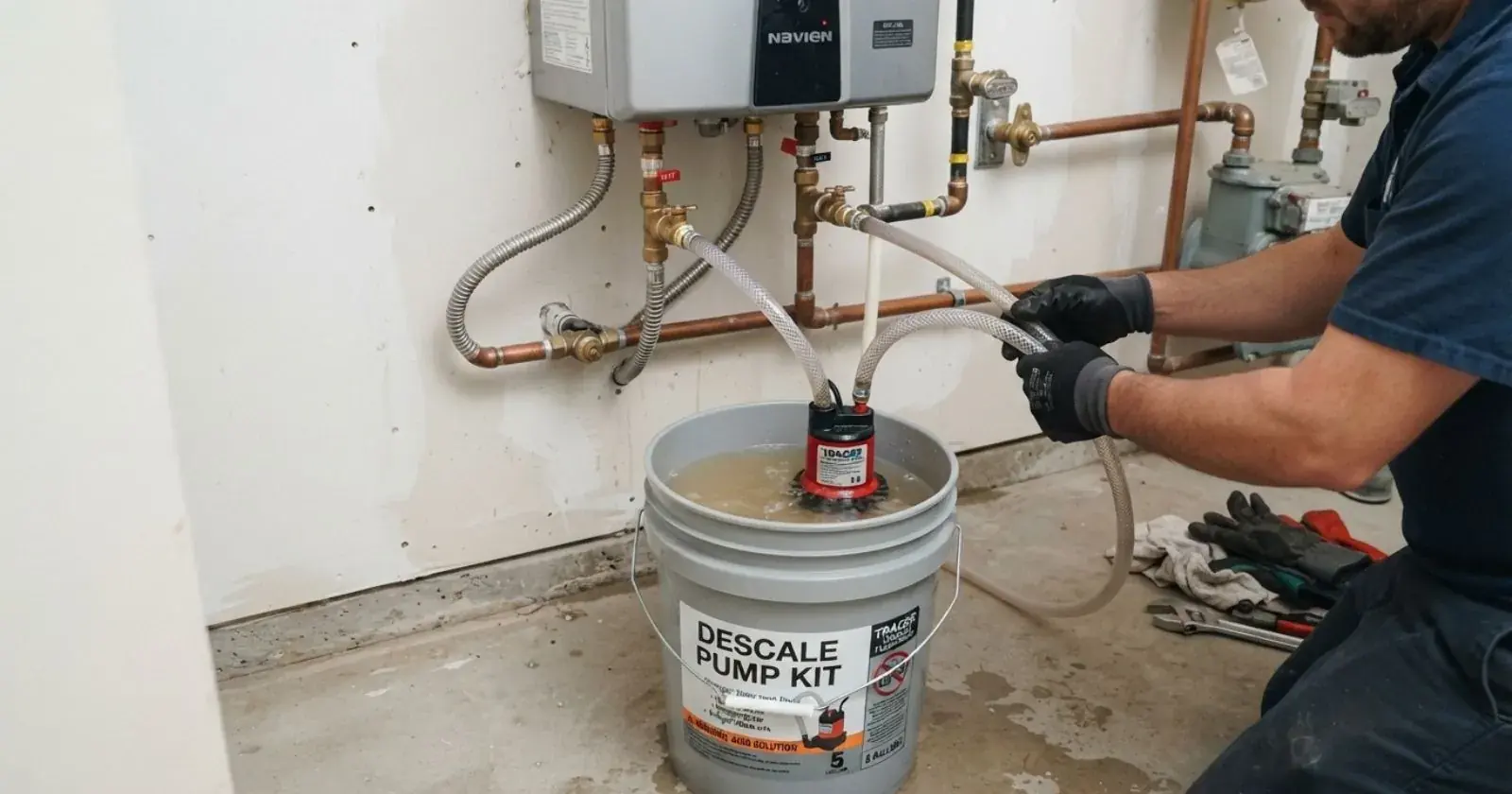
Scale builds on the inside of a tankless heater's heat exchanger and cuts the flow of heat into the water. The unit works harder, throws error codes and eventually fails. A flush circulates a descaling solution through the unit and washes the minerals out.
If you would rather skip the project, our tankless water heater team does flushing as a service.
What you need
- A small submersible utility pump rated for the job.
- Two hoses with fittings that connect to the unit's service valves.
- A five gallon bucket and enough descaling solution or white vinegar for the manufacturer's recommended volume.
- Safety glasses and gloves.
- The installation manual or manufacturer's flushing instructions.
Read your manual first
Manufacturers differ on solution, volume and time. Some approve white vinegar, others recommend their own product. Using the wrong one can harm seals. Follow the manual, and if you cannot find it, search the model number from the label on the unit.
Flush step by step
- Turn off power or gas to the unit and close the water valves.
- Connect one hose from the pump to the cold service valve and a second hose from the hot service valve back to the bucket.
- Pour solution into the bucket and place the pump inside.
- Open the service valves and run the pump so the solution circulates, usually for 45 minutes to an hour.
- Drain the solution, then flush with clean water for several minutes.
- Clean the inlet filter, close the service valves, restore power or gas and test the unit.
Common mistakes
People forget to turn the service valves to the right position, which sends solution to the wrong place. Others use too little time and leave scale in place. Some skip the final rinse, so a vinegar taste lingers in the hot water.
If the unit still throws errors after flushing, the exchanger may be damaged or the problem lies elsewhere, such as venting or gas supply.
Signs the unit needs a flush now
- Error codes that point to flow or temperature faults.
- Water that takes longer to reach a steady temperature.
- Noise such as rumbling or kettle-like popping from the unit.
- Lukewarm output at normal flow.
- A long gap since the last service or none on record.
Safety notes while you work
Wear gloves and glasses because descaling solutions can irritate skin and eyes. Work in a ventilated area. Make sure the unit is off and cool, and that gas or power is isolated as the manual says. If you smell gas at any point, stop and leave the area.
Do not pour descaling solution down a drain that leads to a septic system without checking the product label.
What a professional flush adds
A plumber checks more than the heat exchanger. We look at the vent, the inlet filter, the condensate line, the gas supply and the temperature settings, and we can replace service valves that are missing or leaking. A short visit can catch a problem before it grows, and our tankless water heater page explains the visit.
Typical flush mistakes with brands and models
Every manufacturer has its own valve layout. Some units have three-way service valves with a handle that sits in a particular position. Others have a hot, cold and drain port. If the manual is unclear, take a photo of the valves and the label and call us. We can tell you how that model is flushed.
Never run the unit during the flush. The heating system must be off, and the pump must circulate liquid only.
After the flush
- Turn the unit on and run hot water at several taps to purge air.
- Check that the inlet filter is clean and seated.
- Look for drips at both service valves.
- Note the date of the flush and the product used.
- Watch for error codes over the next week.
Time and effort: what a first flush really takes
Plan on about two hours for a first-time flush, including setup, the circulation period, the rinse and the cleanup. A unit that has never been flushed may need a second run, since heavy scale takes more than one pass. Expect a cloudy or colored solution at the end, which is a sign minerals came off the exchanger.
Keep notes on the date, the solution and the observations. If the unit throws codes again soon, those notes help a plumber diagnose whether the cause is scale or something else.
Where the used solution goes
Descaling solution that has circulated through the unit holds dissolved minerals and sometimes a mild acid. Most homeowners pour it down a utility drain with plenty of water, and the product label tells you if that is acceptable. Do not dump it on plants or into a storm drain. Rinse the bucket, hoses and pump before storing them.
When to stop and call us
Stop if a valve will not turn, if the unit leaks at a service valve, if the solution smells like gas or if error codes persist after two flushes. Forcing a seized valve can crack a fitting. We replace stuck or leaking service valves, flush the unit properly and test the vent, so you are not guessing at the cause.
Safety steps before you start
- Turn off the gas or the breaker so the unit cannot fire while dry.
- Close the water and gas valves before you connect hoses.
- Let the unit cool, because water inside can scald.
- Follow the manufacturer's flush instructions for your model.
How often to flush
Once a year works for many homes. Hard water or heavy use calls for more. Without a hardness figure for your supply, test your tap. A water softener or filter may lengthen the interval.
What Plantation's water report says about scale
The City of Plantation's water quality report does not list a hardness figure, so a home test is the only reliable way to know. The city says its Biscayne aquifer groundwater goes through membrane softening at two treatment plants.
Some tankless owners in Sunrise and Davie receive water from other utilities. The same test applies there.
Call the line, describe it, and we will say whether it can wait.
Tankless flushing questions
Many manufacturers allow it, but some require their own solution. Check the manual.
Error codes should clear, and flow and temperature should improve. A cloudy drain solution shows minerals came out.
Units without service valves need them added before a flush. A plumber can install them.
Yes. The city's water quality report gives no hardness figure, so a test shows how fast scale is likely to form in your unit.