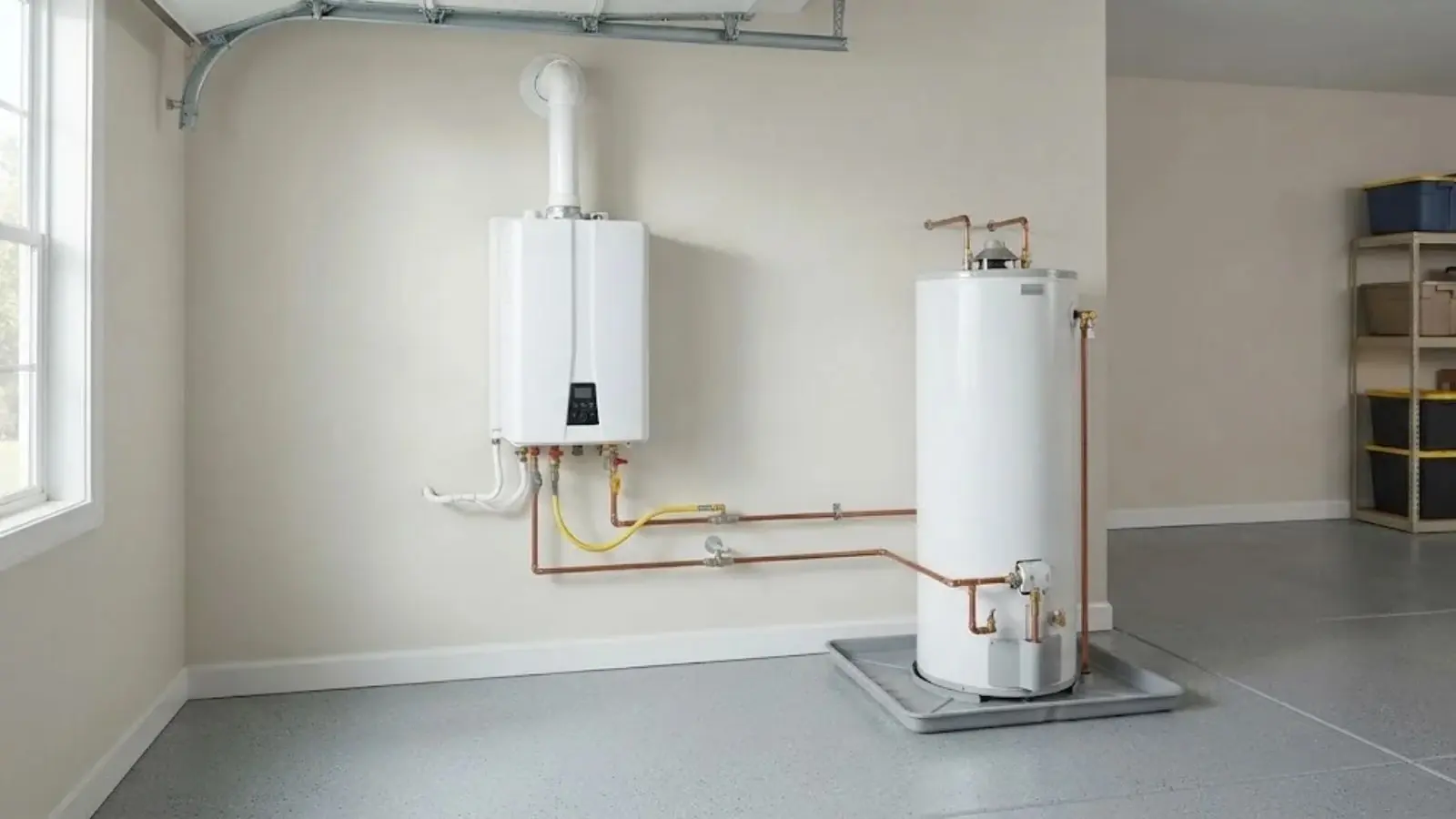
Installation is different from an emergency swap because you have time to choose. You can decide on capacity, fuel and location, and we can plan the work around your schedule rather than a failed tank.
We install in garages, closets, attics and utility rooms. Each location brings its own demands for drainage, clearance, venting and access.
Sizing and choosing the unit
Household size, the number of bathrooms and your morning routine decide the capacity. A family that runs two showers and a dishwasher at once needs more recovery than a couple that showers separately.
We talk through fuel, efficiency, warranty and footprint, and we are plain about trade-offs. Cheaper units often cost more to run, and the most efficient models need more space.
Where the heater goes matters
Garage installs are common in Plantation, and they need protection from impact and a clear route for the relief valve line. Attic installs need a drain pan with a proper drain, because a leak there goes through the ceiling. Closets need combustion air for gas units.
If you are weighing a continuous-supply model, our page on tankless water heater service explains the venting and gas line changes involved.
Code items we include
- A pressure relief valve with a discharge line routed to a safe location.
- An expansion tank where the plumbing system calls for one.
- Shutoff valves, flexible connectors and dielectric fittings that suit the pipe material.
- Strapping that meets Florida code, plus proper venting for gas units.
Permit and inspection in Plantation
Plantation requires a permit for water heater installation. The city offers a same-day permit program for existing single-family homes with a plumbing checklist, and the contractor must be registered in the city system. For new construction or major remodels, the permit is usually part of the larger building permit, and we coordinate with your general contractor.
If your old unit is failing instead, see water heater replacement for the faster path.
Before the installer arrives
Clear the area around the old unit and the new location. Make sure someone over eighteen is home to authorize the work. Tell us if the water is off to other homes in the building. Pets should be kept away from the work area, and we ask that you plan for water to be off for a few hours.
Warranty and registration
Most water heaters carry a manufacturer's warranty. The terms differ, and some require registration within a short period after installation. We give you the model and serial numbers and explain what the warranty covers. Keep the paperwork and the permit receipt together.
Codes and permits for this work
Plumbing in Florida is governed by the Florida Building Code, Plumbing, which is based on the International Plumbing Code (IPC). In practice, a new unit needs a permit, correct venting and a code-compliant relief valve and drain. If you want to know what applies to your address, ask the dispatcher and we explain it before the visit.
What affects the cost of installing a water heater
Installation pricing grows from the unit and from what the location needs.
- Unit type
- Tank, hybrid and tankless models differ in price, and tankless often needs extra gas or electrical work.
- New or existing connections
- A like-for-like swap is quick. A new location needs supply, drain and fuel lines.
- Code requirements
- Pans, expansion tanks, venting and strapping may add parts and labor.
- Finish work
- Patching walls or running lines through finished spaces takes extra time.
You see a written price before the work begins.
Want your real number? Call (954) 697-4920 and describe the problem.
Call the dispatch line and describe what you see. We will tell you what happens next.
Water heater installation questions
A standard tank install usually takes a few hours. A tankless conversion or a move to a new location can take a full day because of venting, gas line and electrical work.
Possibly, if gas service is available and the location can be vented safely. We check the gas line size, venting path and local requirements before we recommend it.
Yes. Removal of the old unit is part of the visit.
In attics and over finished floors, yes. A pan with a drain line gives a leak somewhere to go besides your ceiling.