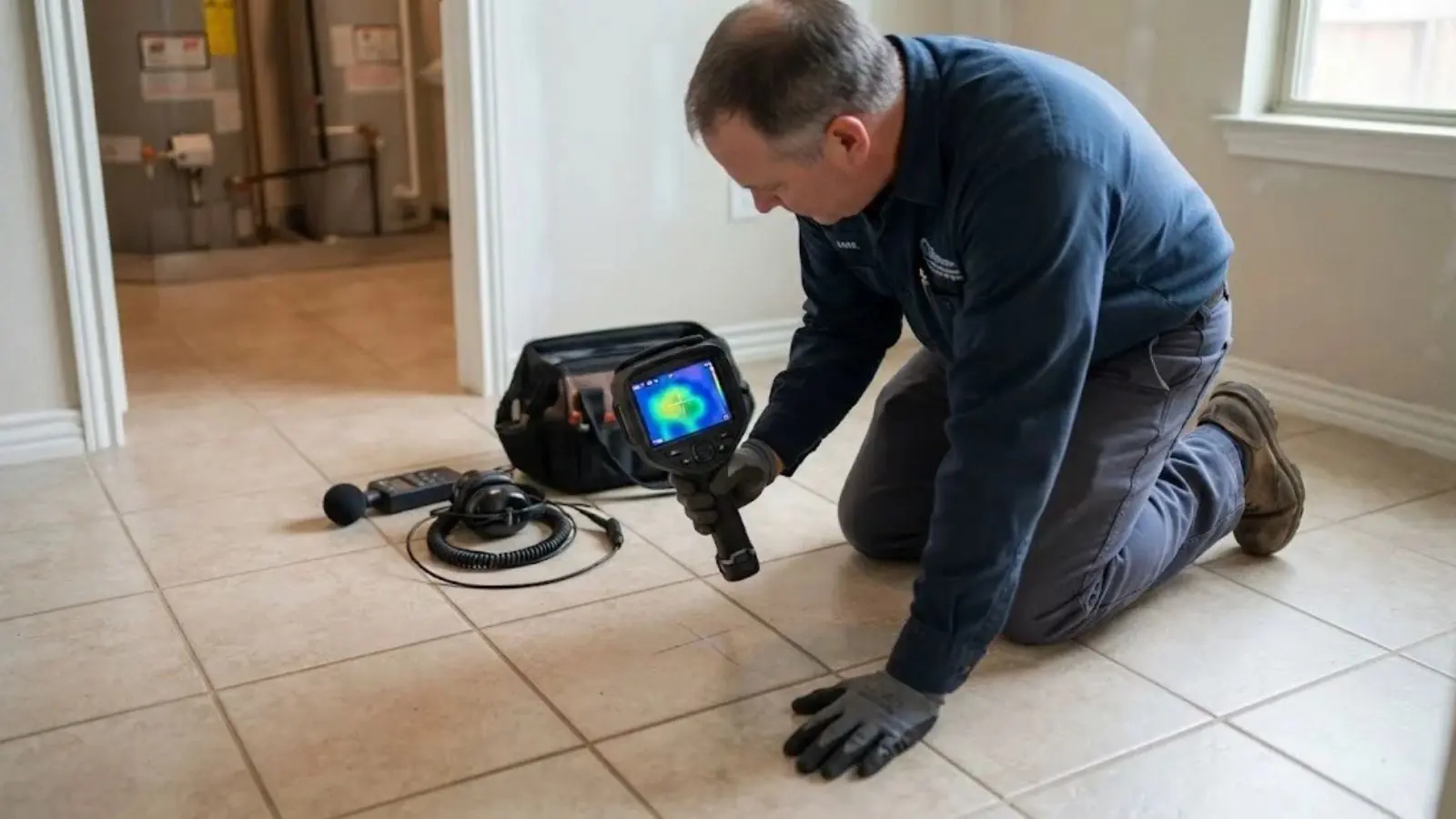
Hidden leaks do their damage quietly. Drywall softens, baseboards swell, tile lifts and mold begins, and the first sign may be a bill rather than a puddle. The goal of leak detection is to find the exact spot so the repair is small instead of a demolition project.
Call when you see wet flooring, stained ceilings, running meters with every fixture off or a sound of water in the wall at night. The earlier we find a leak, the less it costs to fix.
Act fast when you see water spreading
If water is coming through a ceiling or across a floor, shut off the main valve at the house. In many Plantation homes it sits near the front hose bib or at the meter box. Turn it clockwise until it stops.
Then move belongings out of the wet area, switch off power to any room with standing water and call us. Photos of the stain and the water meter help us plan the visit.
Check the meter yourself
A simple test tells you whether water is escaping. Turn off every tap and appliance, then watch the small leak indicator on the meter, which is often a triangle or dial that spins slowly when water moves. If it turns with everything off, something is leaking between the meter and the fixtures.
If the dial moves, close the main valve at the house and watch again. A meter that stops means the leak is inside the house. A meter that keeps moving points to the line between the meter and the home.
How we locate a hidden leak
We combine listening equipment, moisture meters and thermal imaging to narrow the search. Acoustic tools pick up the hiss of pressurized water in a pipe. Thermal cameras show cold or warm patterns behind finishes. Pressure tests tell us which section of piping is losing water.
- Acoustic listening on floors, walls and exposed piping.
- Pressure testing to isolate the hot, cold or irrigation section that is leaking.
- Moisture mapping so any opening in drywall or tile is as small as possible.
Slab, wall and supply line leaks
Many Plantation homes sit on concrete slabs, so a leak in a pipe under the floor is a real possibility. A warm spot on the tile, a hot water bill that climbs or the sound of running water at night may point to it. We cover the repair side on our slab leak repair page.
Leaks in the wall behind a shower or in a ceiling below an upstairs bath are found the same way. After we locate the source, we repair it ourselves or explain what a restoration contractor will need to do.
What to do while you wait for our visit
Shut off irrigation and any appliances you can. Write down the meter reading and the time so we can compare after the visit. Photograph stains, warm spots and anything that sounds wrong, and note when the water bill rose.
If the leak is slow, you can keep the main on and watch it. If it spreads, close the main and call back so we can move you up.
Codes and permits for this work
Plumbing in Florida is governed by the Florida Building Code, Plumbing, which is based on the International Plumbing Code (IPC). In practice, opening a wall or slab to reach a leak is followed by a repair that meets code. If you want to know what applies to your address, ask the dispatcher and we explain it before the visit.
What affects the cost of leak detection
Detection is priced by the effort needed to find the leak, and repair is quoted separately once we know what it takes.
- Size of the area
- A single bathroom is quick to survey. A whole slab or a long yard line takes longer.
- Pipe layout
- Copper, PEX and older materials respond differently to acoustic tools.
- Number of suspected leaks
- Some homes have more than one. We test each section so nothing is missed.
- Access for repair
- A leak behind tile or in a ceiling needs careful opening and closing of finishes.
Your price is stated before work begins, and detection findings come with a clear explanation.
Want your real number? Call (954) 697-4920 and describe the problem.
Call the dispatch line and describe what you see. We will tell you what happens next.
Leak detection questions
If water is actively spreading or soaking a ceiling or floor, yes. Shut the main valve and call us right away. A slow suspected leak seen only on the bill is urgent but can wait for a scheduled visit.
Signs include a warm spot on a floor, the sound of running water with all fixtures off, damp carpet with no source and a meter that spins steadily. Detection equipment confirms the location before any concrete is touched.
Only at the exact point where the leak sits, and we keep that opening as small as we can. Moisture mapping and listening tools let us avoid exploratory demolition.
Yes. A worn flapper can leak many gallons a day without any visible puddle. Dye in the tank is a quick test, and we cover repairs on our toilet repair page.