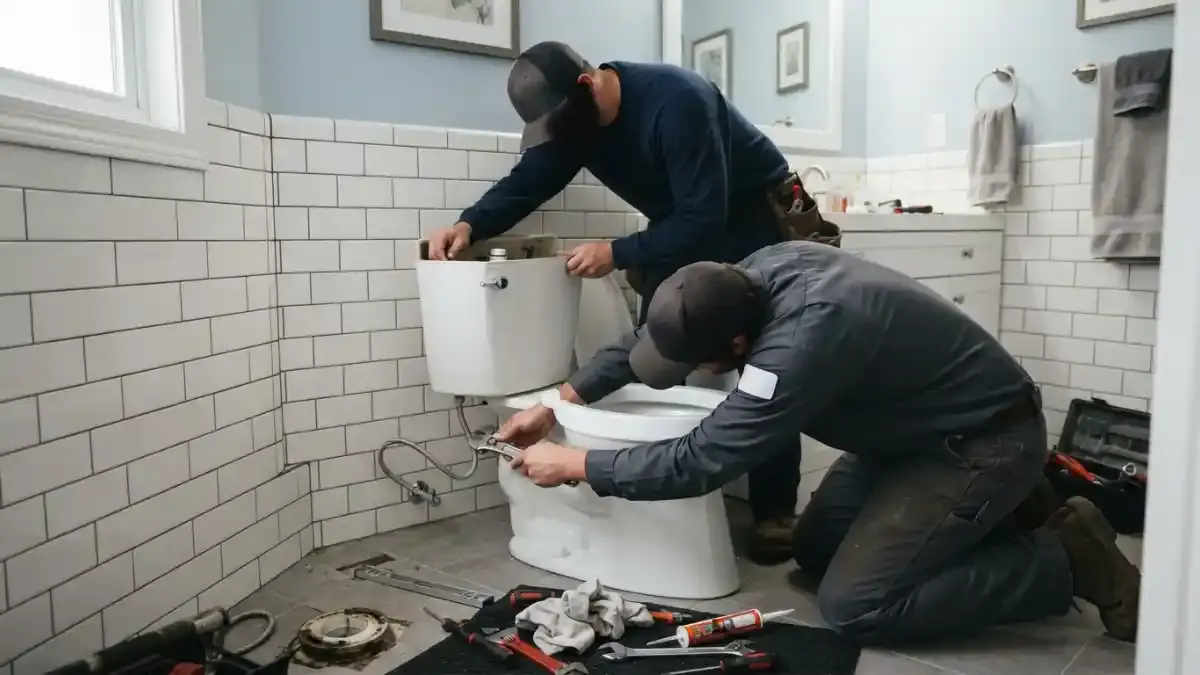
Toilets fail in a handful of predictable ways. They clog, they run, they leak at the base or they rock on the floor. Each has a fix, and most can be done in a single visit.
If water is rising right now, stop it first. The steps below take about thirty seconds.
Overflowing right now? Do this first
- Lift the tank lid and push the flapper down to stop the flow, or close the shutoff valve behind the toilet.
- Turn the valve clockwise until it stops.
- Mop up with towels and keep the area ventilated.
- Call us. Do not keep flushing.
Clogged toilet
A plunger with a flange cup clears most clogs. Wipes, toys and too much paper cause the hard ones. We use closet augers that go past the trap without scratching the porcelain. If several fixtures back up, the problem is the drain line, and our drain cleaning team handles it.
Running or leaking toilets
A toilet that hisses or refills on its own has a bad flapper, a worn fill valve or a float set too high. A running toilet can waste a lot of water, and the water bill shows it. A leak at the base points to a worn wax ring or a loose flange, and it can rot the subfloor over time.
A rocking toilet needs a new seal and often flange repair.
Replacing or installing a toilet
Older toilets use more water per flush than modern models. We install new toilets, set them level, seal them and test the flush. Tell us if you need an accessible height model or a compact one for a small bathroom. If the supply line or shutoff valve is corroded, we replace those too.
Signs a toilet is near the end
Cracks in the bowl or tank, repeated clogs after many repairs, a persistent rocking and a flush that no longer works despite new parts all suggest replacement. Older high-volume toilets also waste water. A new model flushes better and uses less.
We help you choose the right height, bowl shape and rough-in size, so the new toilet fits the space without moving the drain.
Low-flow, comfort height and other options
Modern toilets use less water per flush and clear waste well. Comfort height seats sit a little higher and are easier on the knees. Elongated bowls are common, and round bowls fit tight bathrooms. Tell us who uses the bathroom and we recommend a model that fits.
We also check the flange, the floor and the shutoff valve when we install, since a new toilet on a bad flange rocks and leaks.
Codes and permits for this work
Plumbing in Florida is governed by the Florida Building Code, Plumbing, which is based on the International Plumbing Code (IPC). In practice, a new toilet must meet the flow limits and the clearances the code sets. If you want to know what applies to your address, ask the dispatcher and we explain it before the visit.
What affects toilet repair cost
A fill valve swap is a short job, while a flange repair under the floor takes longer.
- Problem type
- Parts like flappers and valves are modest. Flange and subfloor work costs more.
- Toilet model
- Some brands need specific parts.
- New installation
- The new toilet plus removal of the old one set the total.
- Floor condition
- Rot or tile damage may need additional repair.
You get the price before we start.
Want your real number? Call (954) 697-4920 and describe the problem.
Call the dispatch line and describe what you see. We will tell you what happens next.
Toilet repair questions
Yes if water is reaching the floor or the toilet is the only one in the home. Close the shutoff valve and call us for dispatch.
A worn flapper or a fill valve that does not seal is the usual cause. It is often a quick fix.
It may be a failed wax ring, a loose bolt or a leaking supply line. We find the source and repair it.
Yes. We remove the old one, install a new toilet and test it before we leave.