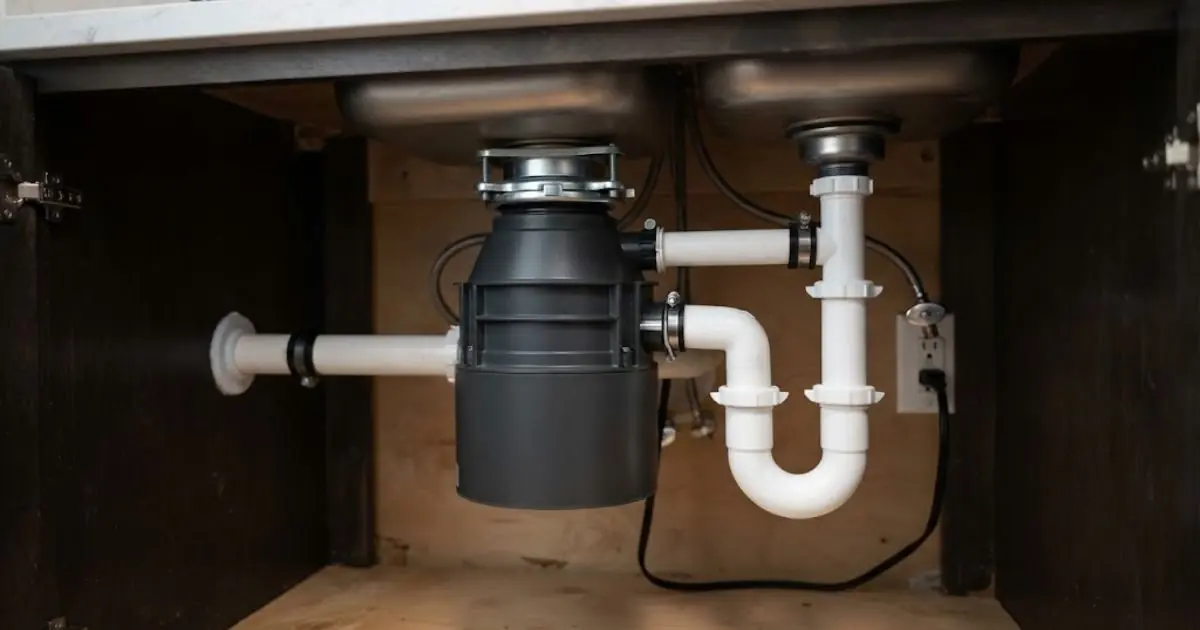
Replacing a garbage disposal is one of the more doable plumbing projects around the house. It involves a mounting ring, a few bolts, a drain connection and an electrical hookup. Done carefully, it takes a couple of hours.
Done carelessly, it floods the cabinet or leaves a live wire exposed. The notes below show where people go wrong, and where a garbage disposal repair visit is the better call.
Before you buy: size, power and feed type
Disposals come in a range of horsepower. A small household that cooks lightly gets by with a modest motor. A family that cooks daily benefits from a stronger one that jams less often. Continuous-feed models run while you push food in. Batch-feed models run only when the stopper is locked, which suits households with small children.
Check the space under the sink as well. Newer units can be taller than the one you are removing, and a tall unit may not clear the drain trap.
Tools and parts to gather
- A new disposal with its mounting assembly and a power cord kit if the unit does not include one.
- Plumber's putty, a flathead and Phillips screwdriver and a hammer.
- Channel-type pliers, a bucket and towels for the water in the trap.
- A new drain flange gasket and a dishwasher drain hose clamp.
- A circuit tester so you can confirm the power is off.
Remove the old unit
- Turn off the breaker for the disposal and confirm with a tester that the wires are dead.
- Place a bucket under the trap and disconnect the drain pipe and the dishwasher hose.
- Disconnect the wires inside the access plate on the bottom of the unit.
- Support the old unit, twist the lower mounting ring to release it and lower the unit out.
- Remove the upper flange by loosening the three screws on the mounting assembly.
Set the new flange and mount the unit
Roll a rope of plumber's putty and press it under the new sink flange, then seat it into the drain opening. From below, slide on the gasket, backup ring and mounting ring, and tighten the screws evenly until the putty squeezes out. Trim the excess putty from the top.
If the new unit has a dishwasher inlet with a plastic plug, knock the plug out with a screwdriver and hammer before you lift the unit into place. Forgetting that step is the most common reason dishwashers back up after a swap.
Wire it safely
Inside the access plate, connect the white wire to white, the black to black and the green or bare wire to the ground screw. Use wire nuts, close the plate and secure the cable with a clamp. If your disposal plugs into an outlet under the sink, that outlet should be in good shape and protected.
If there is no power at the sink at all, stop. Running new wiring is work for an electrician, and a plumber can coordinate the two.
Connect the drain and test
Hang the unit on the mounting ring, align the discharge outlet with the drain pipe and attach the elbow with its gasket. Reconnect the trap and the dishwasher hose. Run water for a minute and check every joint with a dry paper towel. Then restore power and run the disposal with the water flowing.
Check the electrical side before the plumbing
Many sinks already have a switched outlet or a hardwired box under the counter. If yours does, confirm that it is on a circuit that matches the new unit and that the cord or wiring is in good condition. A higher horsepower disposal draws more current, and an older circuit may trip.
If your disposal is hardwired, it needs a cable clamp at the junction and a secure plate. If it plugs in, an outlet that is not protected near a wet sink is a concern, and an electrician can add a protected one.
Mistakes that cause leaks later
- Skipping the plumber's putty under the flange, which leaves a slow seep at the sink.
- Overtightening the mounting ring and cracking a plastic part.
- Reusing a worn drain elbow gasket.
- Leaving the dishwasher hose loose at the inlet.
- Forgetting to test with the water running, since many leaks appear only under flow.
Care after installation
Run cold water for a few seconds before and after each use so scraps move through the trap. Grind small amounts at a time. Skip grease, coffee grounds in bulk, fibrous stalks, bones and starchy foods like pasta and rice, which swell and clog.
Once a month, grind a few ice cubes and a citrus peel to scrub the chamber. That freshens the unit but does not clear a clogged line, and a persistent smell may call for a look at the trap.
Code and safety notes
Florida follows the Florida Building Code, Plumbing, which is based on the International Plumbing Code (IPC). Wiring for a disposal falls under the National Electrical Code (NEC), so switch off the breaker and test the wires before you touch them.
When to hand the job to a plumber
Call us when the drain pipe does not line up, when the cabinet has water damage, when wiring is missing or when a leak will not stop after a retighten. A new disposal on a corroded drain line is also worth a look first, because a stubborn clog downstream makes any disposal back up. Our drain cleaning crews handle that, and our faucet and sink repair team can fix the sink hardware while the cabinet is open.
Plantation sewer facts that matter for a disposal
Everything a disposal grinds ends up in the city system. According to the City of Plantation's wastewater collection page, the city maintains 197 miles of gravity sewer mains, 57 miles of force mains and 125 lift stations. Grease and fibrous scraps are what build up in those lines and in your own pipes.
If your kitchen line runs slow after installing a disposal, nearby neighbors in Sunrise and Davie face the same grease issues. The cure is the same everywhere. Scrape plates, run cold water while grinding and keep fat out of the sink.
Call the line, describe it, and we will say whether it can wait.
Garbage disposal installation questions
A like-for-like swap normally does not, but rules can change with scope. If you are adding new wiring or moving plumbing, ask the city building division before you start.
Small amounts pass through, but they collect in traps over time. Put most grounds in the trash.
The dishwasher inlet plug was probably left in place. Remove the plug from inside the unit and the drain will flow.
It adds solid waste to a system that already carries a lot of it. The city's network of mains and lift stations handles ordinary kitchen waste, and grease and fibrous food are the things to keep out.