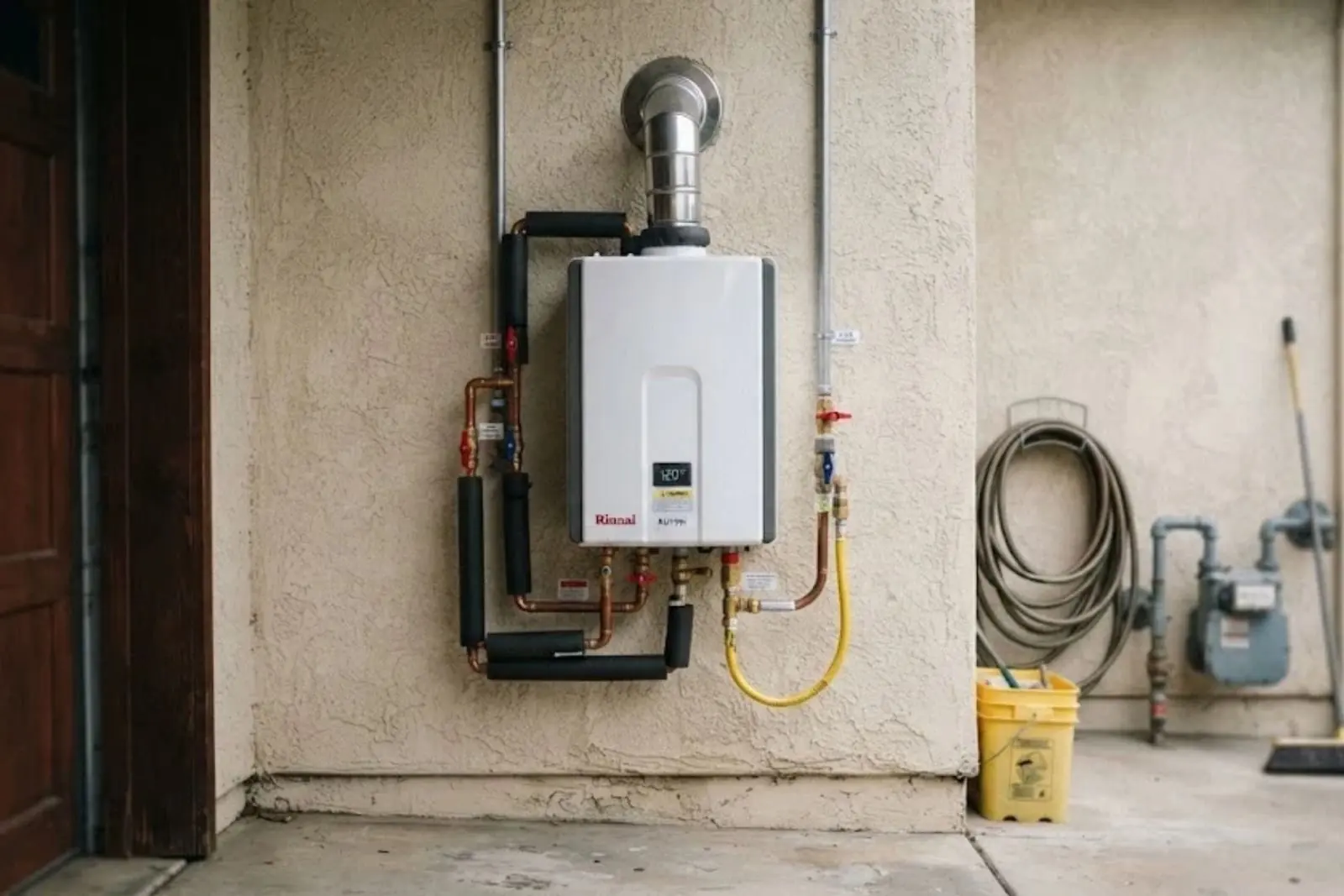
Plug-in tankless heaters use a standard 120 volt outlet. They are real products, and they work well for a hand sink, a utility sink or a distant lavatory. They do not heat a whole house.
This guide explains where plug-in models fit and when you need a larger unit from our water heater installation team.
What a plug-in unit can do
A 120 volt outlet delivers limited power. That is enough to warm a low flow of water, such as a bathroom faucet at a trickle. It is not enough for a shower, which draws far more flow and a bigger temperature rise.
Most plug-in units are marketed for point-of-use. They sit under or near a sink and give hot water without a wait from a distant tank.
Whole-house electric tankless needs far more
Whole-house electric tankless models are hardwired to dedicated 240 volt circuits that can draw very high current. A typical household panel may not have the capacity without an upgrade. If you see a unit sold as a plug-in whole-house heater, check the specifications carefully.
Gas tankless models need a gas line, vent and electrical outlet for the controls. That plug is only for the fan and electronics, not for heating.
Good uses for small point-of-use heaters
- A bathroom or bar sink far from the main water heater.
- A workshop or garage utility sink.
- A guest suite or pool bathroom where running a new hot line is hard.
- A rental or small space where a full heater does not fit.
What to check before you buy
- Read the flow rate and temperature rise on the label.
- Confirm the outlet and circuit are rated for the unit, and that they are protected as needed near water.
- Check water pressure and the type of faucet, since low-flow aerators suit small heaters.
- Plan a way to shut off and service the unit.
Safety around outlets and water
Electric heaters near sinks need care. The outlet should be in good condition and protected for wet locations, and the cord should not run through areas where it can be splashed or pinched. Do not use an extension cord or a power strip with a heater.
Read the manufacturer's instructions. If anything looks unsafe, call a licensed electrician.
Plumbing connections for a small unit
A point-of-use heater needs a cold supply, an outlet for hot water to the faucet and, on some models, a pressure relief arrangement. Hot lines should be short and insulated. Use shutoff valves so you can service the unit without draining the house.
If the faucet has a low-flow aerator, a small heater often suits it well. A high-flow tap will exceed what the unit can heat.
Comparing small options
| Option | Strength | Limit |
|---|---|---|
| Plug-in tankless | Compact, fast to install | Low flow, one fixture |
| Mini tank heater | Gives a small reserve of hot water | Takes space and holds only a few gallons |
| Hardwired point-of-use | More power for a lavatory | Needs a dedicated circuit |
| Extend the main heater line | Uses the existing heater | Wait time and heat loss in long pipes |
Why 120 volts limits the heat you get
Heating water takes a lot of energy. A shower might call for tens of thousands of BTUs per hour, and a standard household outlet supplies a small fraction of that. A plug-in unit can warm a trickle, enough for hand washing, but cannot keep up with a shower. That is a limit of physics, not of brand.
If a product claims to run a whole shower on a regular plug, read the specs closely and look for the flow rate and temperature rise.
When to choose a larger heater instead
- You want hot water at several fixtures.
- More than one person uses hot water at once.
- The point-of-use location is already close to the main heater.
- Your panel can support a larger unit with an upgrade.
- You are already replacing an aging tank.
Reading the label before you buy
Look for three numbers. The flow rate in gallons per minute tells you how much water it can heat. The temperature rise tells you how many degrees it adds. The power rating in watts or amps tells you what the outlet must supply. If any of the three is missing, ask the seller.
Also check whether the unit is rated for a wet location and whether the manufacturer permits a cord and plug connection.
A note on guest houses and pool baths
Backyard guest houses and pool bathrooms are the classic spots where a plug-in heater makes sense, because running a new hot line from the main house is costly. Check that the outlet and the wiring are in good shape, and plan for a simple shutoff so you can service the unit without draining the building.
Noise, space and servicing
Small heaters are quiet compared with large burners, though some hum or click when they start. Allow room around the unit for airflow and for a hand to reach the valves. Mount it where a leak will not reach electronics or finished cabinets, and keep the label visible so the model number is easy to read later.
Electrical limits and codes
Small units follow the National Electrical Code (NEC) for outlets and circuits, and the manufacturer's instructions set what they can run. Florida follows the Florida Building Code, Plumbing, which is based on the International Plumbing Code (IPC). Check both before you buy.
When to bring in a plumber
Call when the supply lines need adjusting, when the unit sits under a sink with little space or when you want to compare the point-of-use option against a bigger heater. We also advise when a full replacement makes more sense, and our water heater replacement page explains that path.
Plantation water and small heaters
Plantation Utilities treats groundwater from the Biscayne aquifer with membrane softening, according to the city's water treatment page. The city's water quality report does not list hardness, so test your tap. Scale can coat small heating elements, and a sediment filter ahead of the unit helps.
If you live near the border, similar guidance applies in Lauderhill and Tamarac, though each city supplies its own water.
Call the line, describe it, and we will say whether it can wait.
Plug-in tankless heater questions
Not in most cases. A 120 volt outlet cannot supply the power a shower needs.
Only if the outlet is missing or not suited to the location. Outlets near sinks should be protected.
Some small units have a mini tank, and others heat on demand. Read the product description.
The city's report does not list hardness, so we recommend testing your tap. If scale shows, a sediment filter or periodic descaling helps.