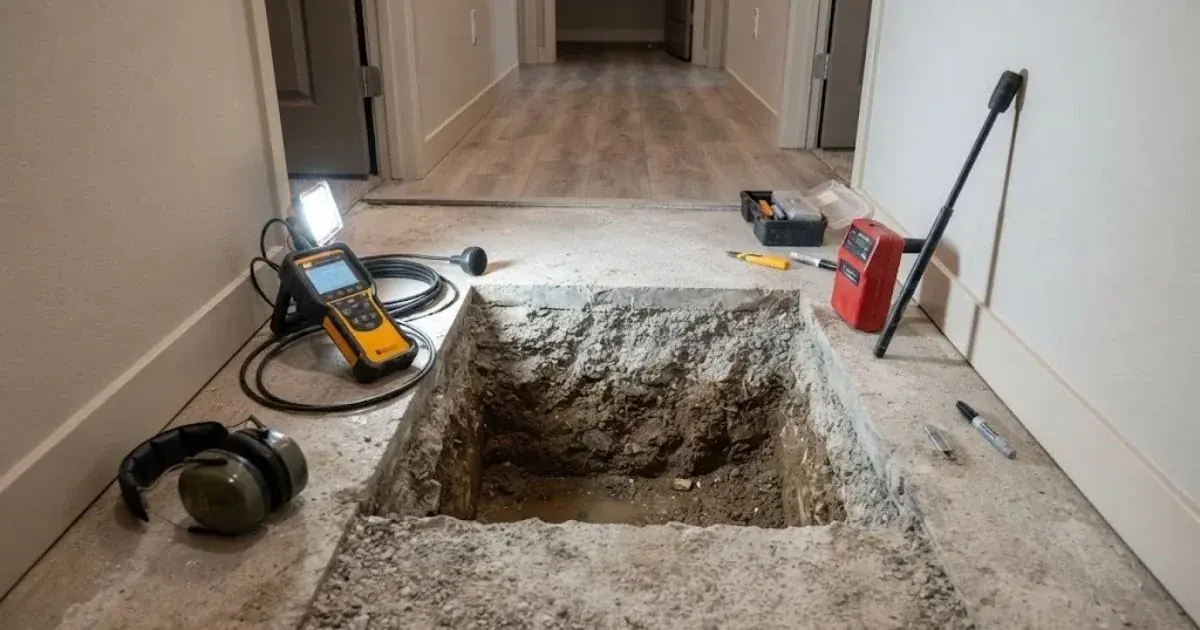
Homeowners facing a slab leak ask the same question. Do we fix this one spot and move on, or do we replace the pipes so it never happens again?
The answer depends on what failed and what else is likely to fail. This guide lays out the decision, and our slab leak repair page covers the repair side.
Start by understanding why the pipe leaked
A single leak caused by a bad joint or a one-time stress is a different case from a pipe that is corroding all along its length. Ask what material your supply lines are made of and how old they are. Ask the plumber to look at the pipe that was removed. If the wall is thin and pitted, the next leak is on its way.
Three paths
| Path | Good fit when | Watch for |
|---|---|---|
| Spot repair | One leak and sound pipe elsewhere | Another leak may appear later |
| Reroute | A single line under the slab keeps failing | Needs wall or attic runs and finish repairs |
| Whole house repipe | Several failures or a risky material | Larger upfront project |
Signs that point toward repiping
- More than one pinhole leak in a year.
- Polybutylene, galvanized or other aging pipe.
- Discolored water or falling pressure throughout the house.
- A leak history that includes repairs in different rooms.
- Pipes with visible corrosion when exposed.
Signs that a spot repair is enough
A newer home with a recent leak from a clear cause, such as a damaged joint, can often be fixed in place. If the rest of the system tests well and the pipe is in good shape, spot repair is the economical choice. We confirm with pressure tests and, where possible, a look at the removed section.
What rerouting involves
Rerouting abandons the leaking line under the slab and runs a new one through walls or the attic. It avoids tearing into more concrete and gives future access. It needs openings in drywall and finish repairs, so we plan it with you. It sits between spot repair and a full repiping.
Questions to ask your plumber
- What caused this leak, and is the rest of the pipe in similar condition?
- What happens if I choose a spot repair now and another leak shows up?
- What will rerouting involve in walls and ceilings?
- How long will the project take and what will be unavailable?
- What permits and inspections apply?
Thinking about cost without a single number
The cost of each path depends on the house. A spot repair is the smallest single project, but several of them over the years can add up. Rerouting costs more but can end a recurring leak. Repiping is the largest project and addresses the system as a whole. Ask each option to be priced in writing so you can compare.
Timing and living at home
A spot repair may take a day. Rerouting takes longer and may involve openings in several rooms. A whole house repipe can take several days, and water will be off for part of each one. Plan for alternatives for cooking and bathing, and ask your plumber for a daily schedule.
What a camera and a pressure test tell you
A pressure test shows whether the system holds under normal pressure. A drop over time confirms a leak and tells you which section is losing water. A camera cannot see inside a supply pipe in the same way it sees a drain, but a plumber can still evaluate exposed sections, fittings and the condition of what we remove.
These checks help you decide with facts, not fear.
Where leaks tend to show up first
- Under the slab near the water heater or the main entry.
- In hot water lines, which work harder and wear faster.
- At fittings and elbows, where flow changes direction.
- Where pipes pass through the slab and rub against concrete.
- Near a past repair that was poorly done.
Mistakes to avoid when deciding
- Choosing a repipe only because someone is pushing it.
- Choosing a spot repair only because it is cheaper today.
- Ignoring discolored water or low pressure as unrelated.
- Skipping a pressure test.
- Failing to get the scope in writing.
Resale and inspections
Buyers and inspectors ask about plumbing in older homes. A documented repipe, with permit and inspection records, answers the question. A series of spot repairs on aging pipe can raise concerns. Keep every invoice and permit receipt, and ask your plumber to describe what was done in plain language you can share.
A simple way to choose
If this is the first leak and the rest of the system looks good, repair it. If leaks keep returning or the pipe is a known problem type, price a repipe and compare. If one line under the slab is the repeat offender, price a reroute. Whatever you choose, get it in writing and keep the records.
Permits and codes for slab work
Florida follows the Florida Building Code, Plumbing, which is based on the International Plumbing Code (IPC). A reroute or repipe usually needs a permit and an inspection before walls are closed.
Plan for the water damage too
A slab leak can soak flooring and baseboards. Dry the area promptly, and keep photos. A restoration contractor can handle the drying, and your insurer can explain what is covered. We repair the plumbing and document what we find, including the location of the leak and the condition of the pipe.
Plantation's housing timeline and your pipes
The City of Plantation says it was incorporated on April 30, 1953 and grew quickly through the 1970s to the 1990s. Homes built in different parts of that window used different pipe materials, and polybutylene was sold in the United States over a stretch of those decades. Confirm what your house has before you decide.
Slab homes are common across the area, including nearby Sunrise and Davie, so the same decision comes up on both sides of the border.
Call the line, describe it, and we will say whether it can wait.
Slab leak and repipe questions
Not always. If the pipe is sound and the leak had a clear cause, a spot repair or reroute may be enough.
Look at exposed pipes near the water heater or under sinks. Copper is brown or green, PEX is plastic in red, blue or white and polybutylene is gray plastic.
It removes a common worry for buyers and inspectors. The effect on price depends on the market.
Homes built through the 1970s to 1990s growth may contain galvanized or polybutylene pipe. An inspection tells you what is actually in your walls.