A sudden jump in the water bill is the most common first sign of a hidden leak. Before you call anyone, a simple test at the meter tells you whether something is leaking at all.
It takes about five minutes and needs no tools beyond a screwdriver to lift the meter lid. Our leak detection team picks up from there if the test points to a leak.
Find the meter and read the dials
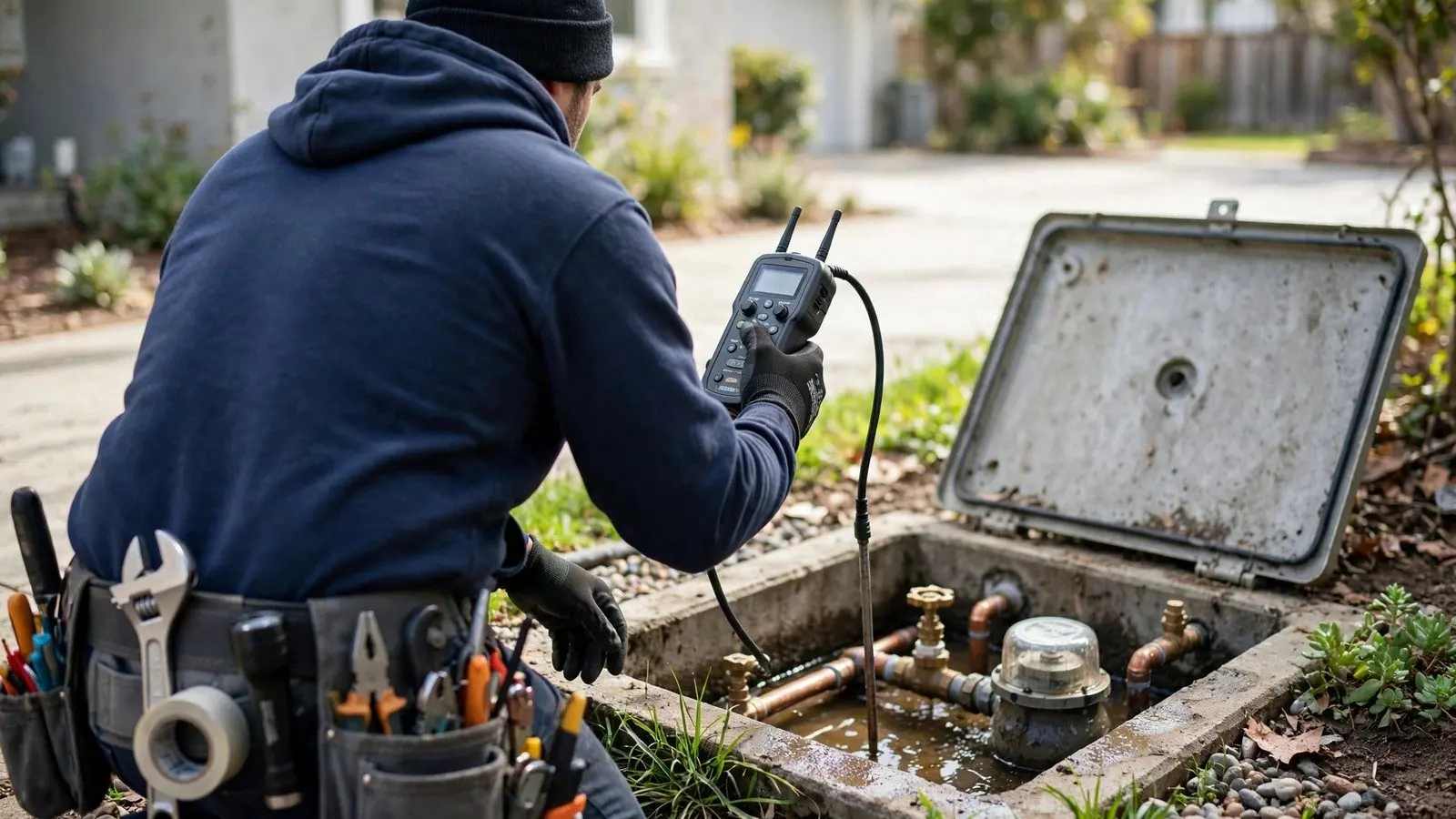
The meter usually sits in a ground-level box near the street or driveway, under a lid. Lift it carefully and check for insects first. Wipe the glass face. You will see a row of numbers like an odometer and, on many meters, a small dial or triangle called the leak indicator that spins when even a trickle moves through.
The test, step by step
- Turn off every faucet and appliance. Stop the dishwasher, washing machine and ice maker, and make sure no one flushes.
- Check for other water uses, such as irrigation timers, pool fill valves and water softeners.
- Look at the leak indicator. If it spins, water is moving.
- If your meter has no indicator, write down the numbers, wait fifteen to thirty minutes with everything off and read again.
- If the numbers changed, you have a leak.
Narrow it down: inside or outside
Close the main valve at the house and check the meter again. If the dial stops, the leak is inside the house. If it keeps moving, the leak is on the line between the meter and the home, often in the yard.
Then work through the usual suspects. Toilets are the leading cause of wasted water. Add dye to the tank and watch the bowl. Check hose bibs, irrigation zones and the water heater relief line.
Other signs that match the test
- Wet or soft turf that stays green when the rest is dry.
- The sound of running water with everything off.
- Warm spots on the floor, a sign of a hot water line leak under a slab.
- Musty smell or peeling paint near a wall.
- Pressure that drops without a cause.
What to do if the meter keeps moving
If you have shut the main and the meter still turns, call us. A yard leak calls for water line repair. If the dial stops when the main is closed but moves otherwise, the leak is in the house. A slab leak is a possibility, and we cover it on our slab leak repair page.
Common leaks the meter test points toward
| Clue | Likely place | Next step |
|---|---|---|
| Dial stops when main is off | Inside the house | Check toilets, faucets and the water heater |
| Dial keeps moving with main off | Between meter and house | Look for wet ground and call for a locate |
| Hot side only is warm under floor | Hot line under the slab | Call for leak detection |
| Moves only when irrigation is on | Sprinkler zone | Check heads and valves |
Check the toilets first
Toilets are the leading cause of hidden water waste. Add a few drops of food coloring to the tank, do not flush and wait fifteen minutes. If color shows in the bowl, the flapper leaks. A toilet that runs on its own after flushing has a worn fill valve or float.
Check every toilet in the house, including guest and rarely used ones.
Then the usual suspects
- Hose bibs and irrigation backflow devices that drip.
- Water heater relief valve lines that run.
- Dishwasher and washing machine supply hoses.
- Ice maker lines behind the refrigerator.
- Pool auto-fill valves that never close.
Reading a meter that uses a different style
Some meters have a sweep hand that circles a dial in cubic feet or gallons. Others have a digital display that alternates between volume and flow. Learn which you have by looking at the label and the units. A digital meter may show a leak alert, and a sweep hand that moves while the house is idle tells the same story.
If you are unsure, take a photo and call us. We can read it with you.
Do not forget irrigation and pools
Irrigation systems, pool fills and outdoor spigots are often on the same meter. A zone valve stuck partly open will keep the meter moving even if you see nothing in the house. Turn off the irrigation controller and close the valve to the pool fill during the test. If the meter stops, you have found it.
How much a small leak can waste
A drip that fills a cup in a minute can waste hundreds of gallons in a day. A running toilet can pass many gallons an hour. Even a slow leak adds up over a billing period. Fixing it early saves money and prevents damage to floors, walls and soil.
If the meter test shows even a faint movement, treat it as a real leak and find it.
If the meter test is negative
A meter that stays still with everything off is good news, and it rules out most leaks. If your bill is still high, compare it with the previous months, check for a change in household use and look at irrigation schedules and pool fills. If the numbers still do not add up, call the utility and ask for a meter check.
Keep records for your bill
Write down the meter reading and the date before and after your test. Take photos. If your bill spiked, ask the water utility whether it offers any adjustment for a repaired leak, and bring your repair invoice. Policies vary, so ask rather than assume.
Plantation Utilities and your meter
Plantation Utilities supplies water from the Biscayne aquifer and treats it with membrane softening at two plants. That is the water passing your meter. If your usage shows a spike on the bill, ask Plantation Utilities for your meter read history so you can see when the change began.
The same test works for customers in Sunrise, Davie and other cities, though each utility has its own contact line.
Call the line, describe it, and we will say whether it can wait.
Meter test questions
Yes. A toilet that leaks into the bowl can pass many gallons. Test it with dye.
Write down the reading, wait without using water and read again. Any change means water moved.
Yes. Turn off irrigation first or run the test during a time it is off.
Plantation Utilities. Ask customer service for the read history for your account.